Customizable archives solution
Archives, libraries, museums in one
Long-term digital preservation
Library system with event management
Library system for multi-branch or consortia libraries
Resource sharing across libraries
Customizable library & knowledge solution
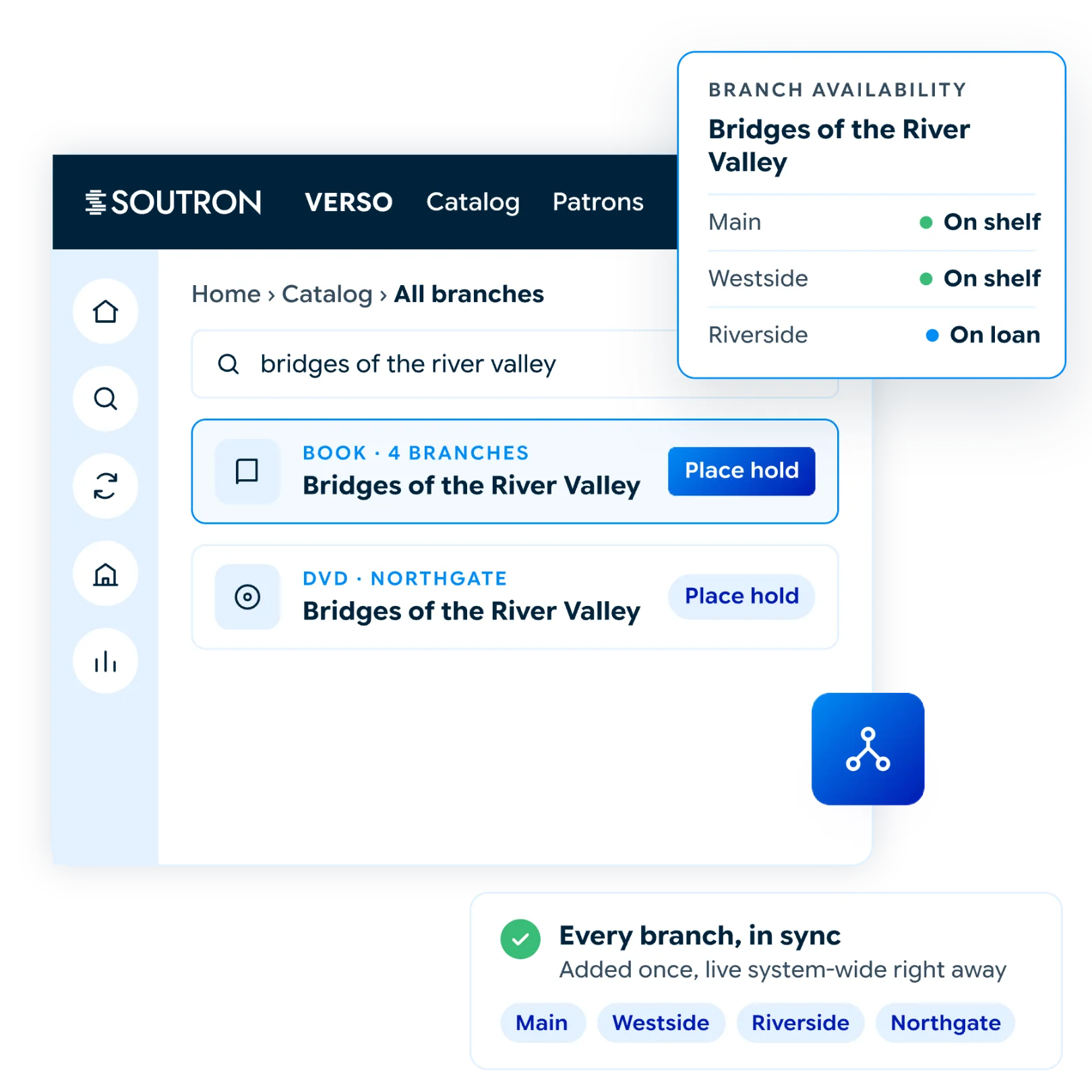
Verso is highly customizable library automation software that keeps every branch in sync with unified reporting. Sized to your library, scalable from a handful of branches to a statewide consortium, Verso expands to meet your needs.
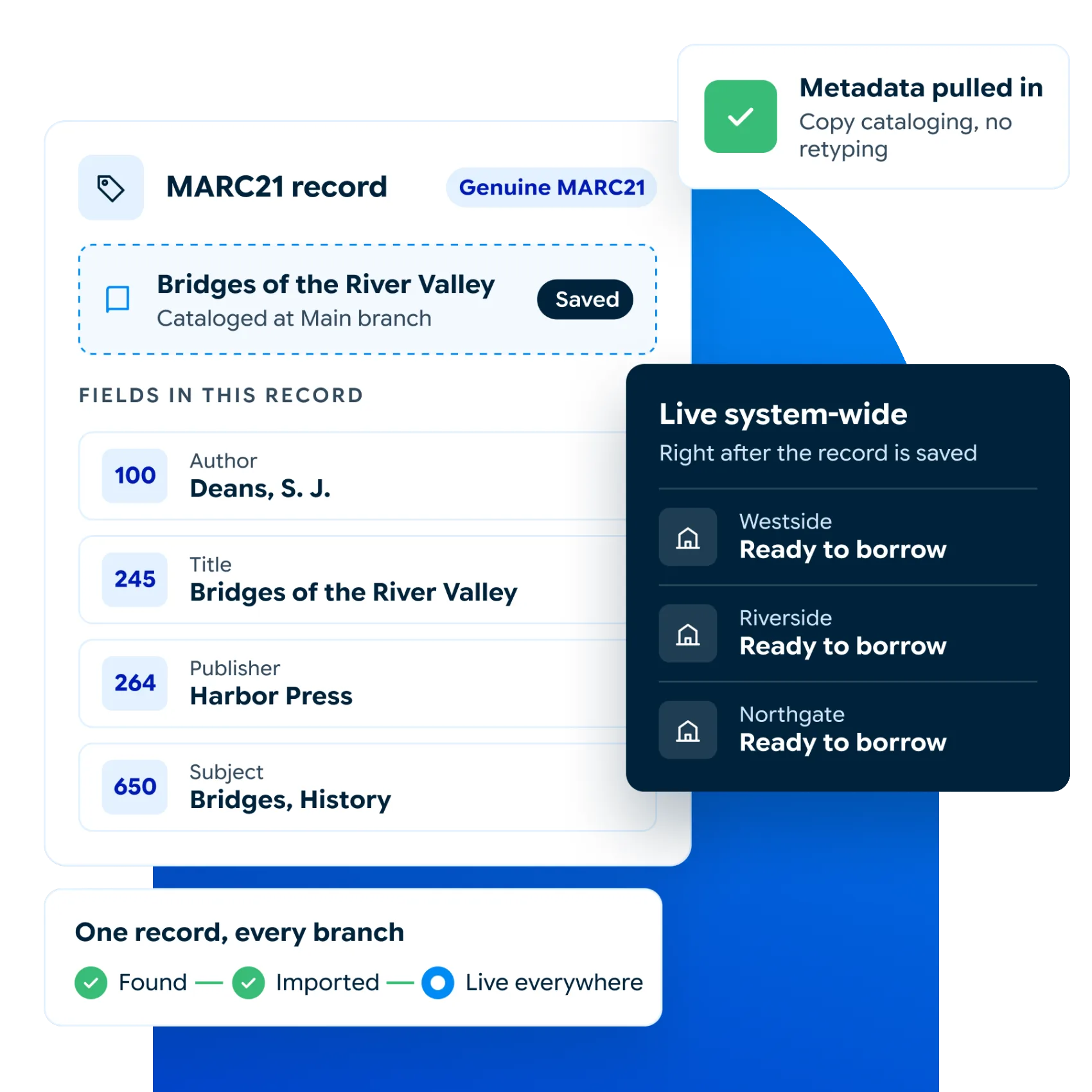
✓ Cataloging your team already knows: MARC21 across every branch, with informed and customizable authority control for individual branch collections.
✓ Individual library policies allow each library to create different circulation parameters for users registered at different libraries.
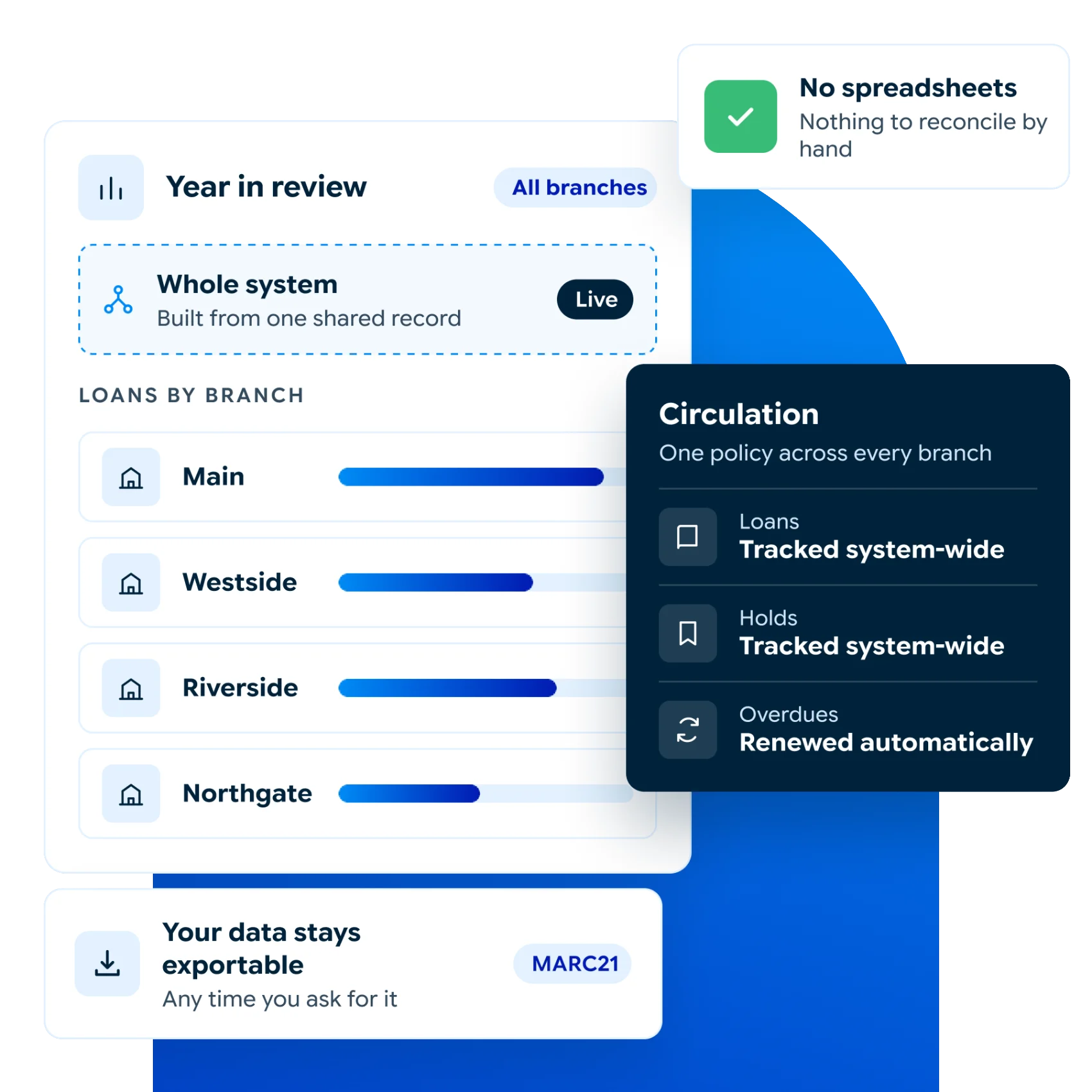
✓ Reports and notices can be run for a single library in a consortium or, with proper permission, globally for all members.
adaptable to meet your library automation needs
displays title and cover art on screen for virtual shelf browsing
designed for MARC21, not an approximation of it
from a handful of branches to a statewide consortium
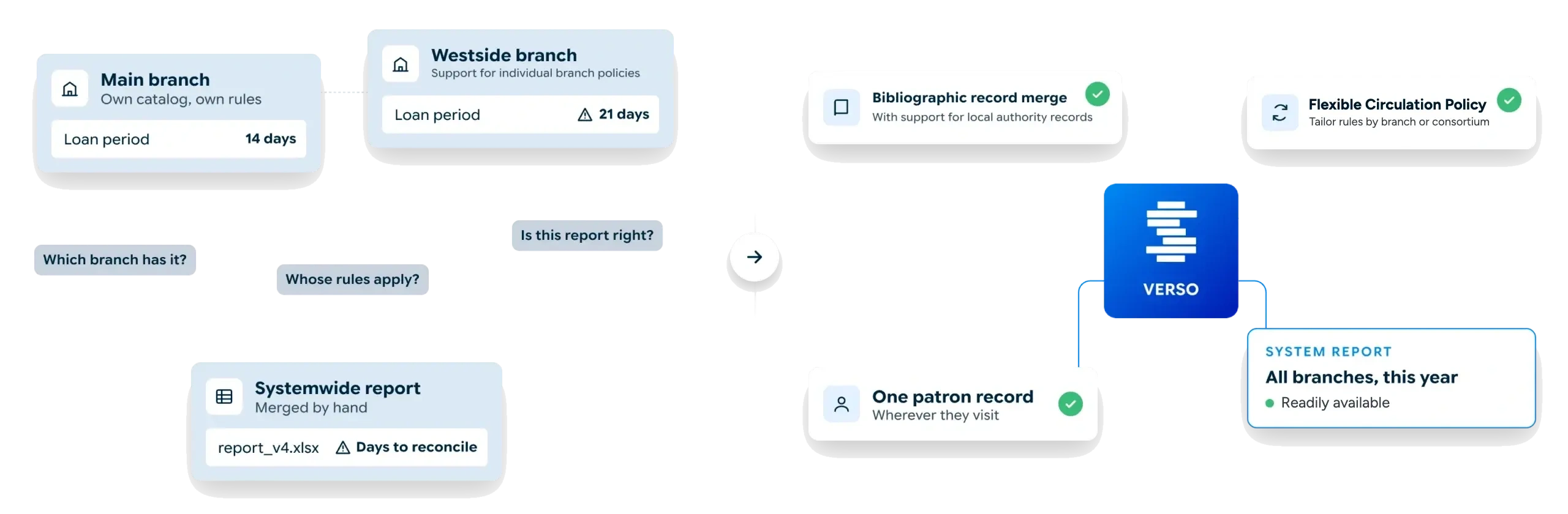
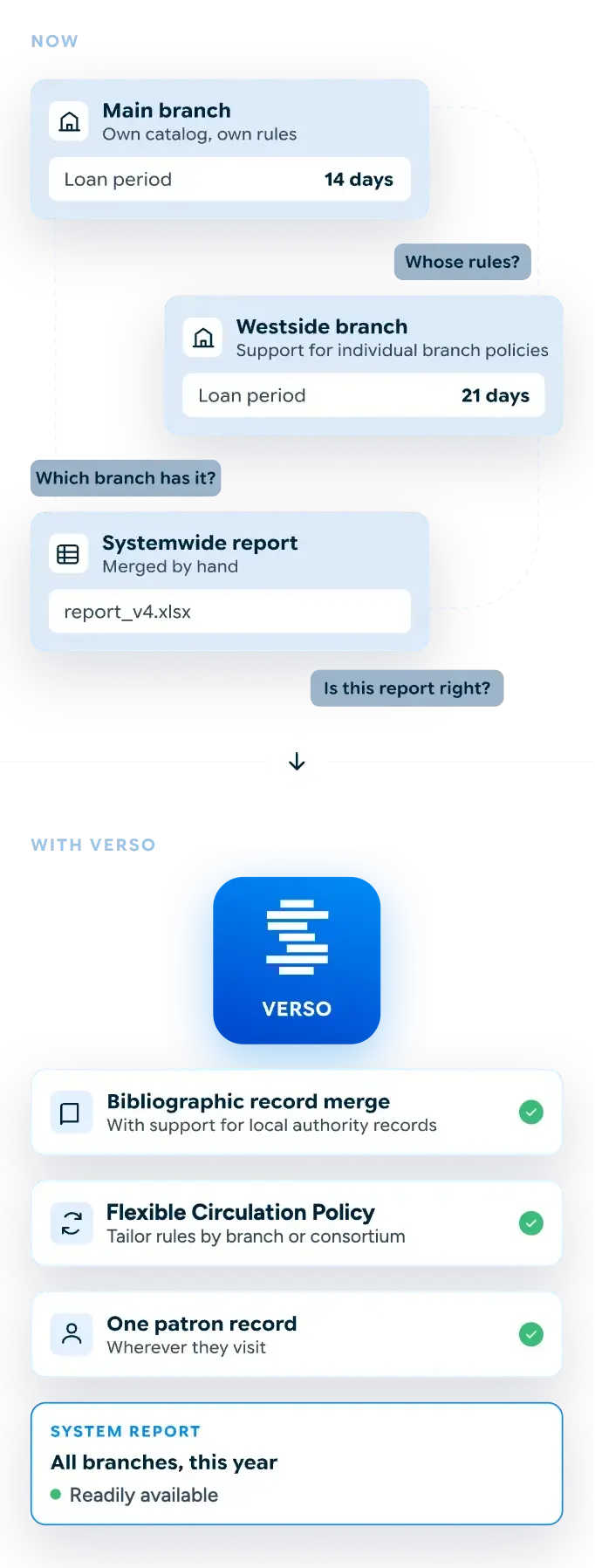
Legacy system built around one shared database that doesn’t bend to local records or circulation rules. Hard to track inter-branch transfers. Weak cross-branch reporting.
Catalogs, circulation rules, and patron data can’t be adjusted on a per-branch basis. Floating collections take many days to reconcile.
Shared regional bibliographic database with local authority control for local holdings.
Cataloging, patron discovery, circulation, and reporting all come built into Verso, with local autonomy options for each branch.
Verso delivers localization and centralization options to satisfy diverse consortium needs.
→ Bibliographic Record Merge allows consortium administrators to select and merge multiple bibliographic records into a single record
→ Libraries that use a shared bibliographic database can use Local Authority Control to enter and authorize their own headings
→ A kids’ catalog with its own colorful, simple interface, built for young readers from the ground up
A search experience that works the way patrons already expect a website to work: fast, on any device, with enough of the shelf-browsing feel that looking around online doesn’t feel like a chore.
→ Libraries can configure their default searching to be at the library level, the consortium level or even the state level
→ Each library in a consortium can manage its default search indexes, menu and arrangement of search resources and its own way of grouping and displaying search results
→ Each library in a consortium can manage its linkages to enhanced content, such as bookstores, Google, Zinio, OverDrive, OneClickDigital, etc
Verso streamlines check-in/check-out processes, provides easy management of patron accounts and handles fines and fees.
→ User transaction policies can be based on the user’s home location or on the location where the transaction is taking place
→ The system supplies detailed ‘in-transit’ reports, including information about what’s coming to the library and what has been sent to other libraries
→ Individual library policies allow each library to create different circulation parameters for patrons registered at different libraries
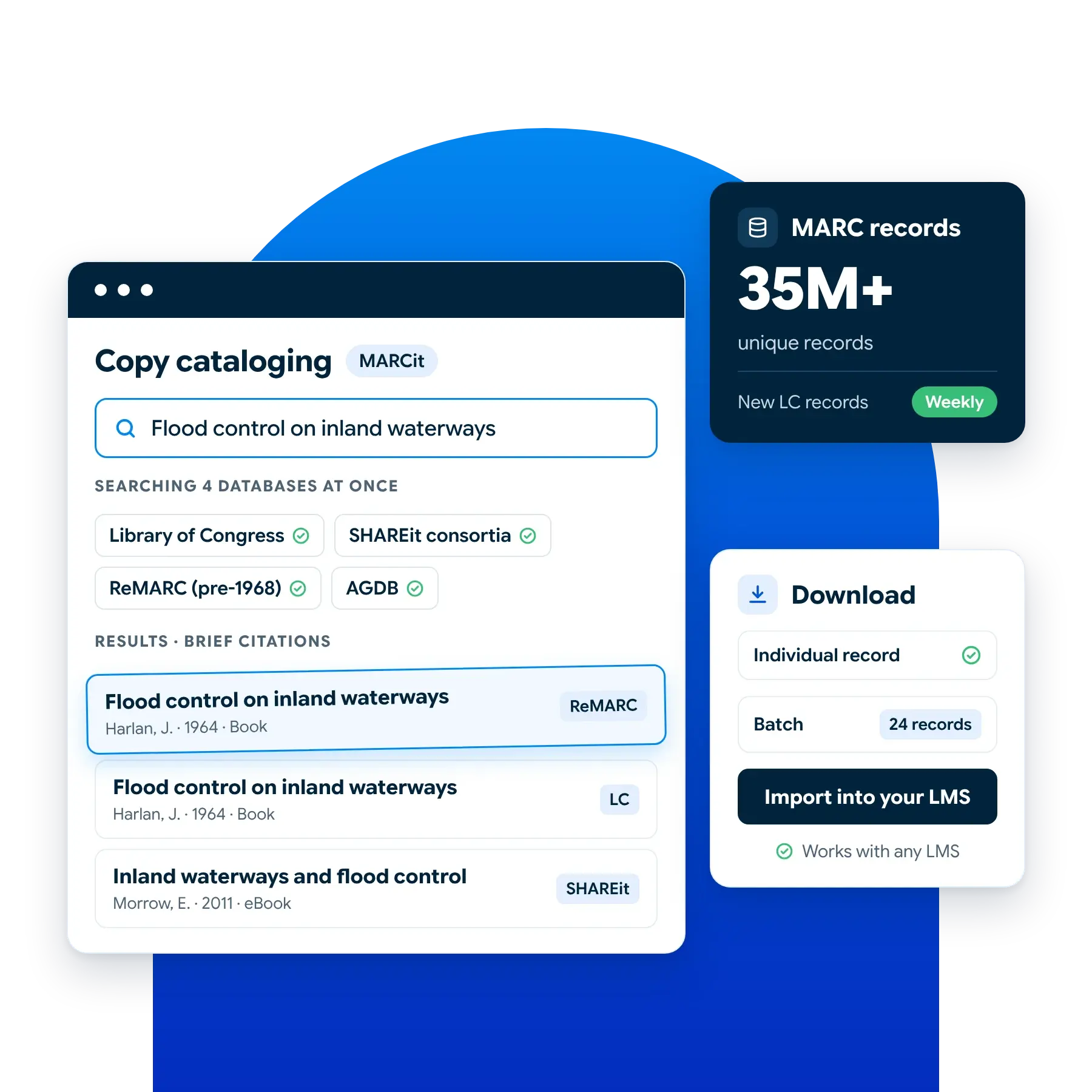
Access over 35 million unique MARC records, updated weekly with new records from the Library of Congress and other verified sources. MarcIt works with any LMS, so you can cut copy cataloging costs, reduce reliance on expensive book vendor records and free up staff time.
→ Records from LC, ShareIt consortia, ReMARC (pre-1968), and AGDB public library databases
→ Pull records from an unlimited number of sources into one unified, customizable discovery layer
→ Export records individually or in batches, ready to import into your LMS where licensing allows
Software, maintenance, support and hosting are covered in one annual fee. ShareIt and MarcIt are separate products you add only if you need them.
Open-source systems have built-in security issues. Verso handles them in the cloud and encrypts every transaction.
Verso’s patron catalog is designed to meet WCAG 2.0 AA, and young readers get their own Kids Catalog.
MARC21-based records
Apollo for single branches and Verso for multi-branch systems and consortia.
Apollo is built for small libraries where one manager runs everything. Circulation, cataloging, patron notices, room bookings, and board-ready reports, all in one place.
Verso is highly customizable and eliminates the friction associated with central control and branch autonomy needs. Built for systems of any size, from a few branches to a statewide consortium.
ShareIt and MarcIt are their own products, each solving one specific problem, sold separately so you only add what you actually need.
ShareIt works with Verso and Apollo. Embedded in Verso, it lets patrons request a title from any library sharing your ShareIt system without leaving the ILS they use. Sixteen US states and British Columbia already run on it, reaching 942 libraries (2026) through its ISSI network, at no added cost to join.
Search 35 million existing MARC records instead of cataloging one more title by hand. Updated weekly, and it exports to any LMS, not just Verso.
Get implementation, training, and everyday support with every system, plus a world-class support team ready when you need help.
Get around-the-clock coverage Monday to Friday, with a four-hour response commitment and most tickets answered in 20 to 30 minutes.
Connect with the team and other customers using the same modules. Hear about updates first, share what works, and shape what’s next.
Hand implementation to a delivery team that runs it end to end, from data migration to portal design. We do the heavy lifting so you get up and running quickly.
Train hands-on with every implementation.
Kick-Off
Portal Design
Data Mapping & Migration
Hands-On Training
Hypercare
Ongoing Support
The questions we get the most, answered here first.
Apollo is built for single-branch public libraries. Verso is built for libraries running more than one branch, in a Multi-branch or Consortia edition. Same MARC21 foundation, same cloud-hosted simplicity, sized differently.
It comes down to how many branches you run, not how many features you’d like. Just one: Apollo. More than one location: Verso’s Multi-branch edition. A regional or statewide group: Verso’s Consortia edition. A K-12 school library: Artemis, not either of these.
Verso and Apollo are the core system: cataloging, circulation, and the catalog your patrons search. ShareIt offers interlibrary loan across a group of libraries. MarcIt speeds up cataloging by searching existing MARC records instead of building new ones from scratch.
Verso is built on MARC21 and supports cataloging with RDA. Apollo is built to handle MARC 21, with an editor designed to assist users and minimize manual tag manipulation.
Software, maintenance, support, and hosting. That’s the whole bill, with no separate module fees showing up partway through the contract.
No. Both are contract-free, with plain, easy pricing and nothing hidden in the fine print. Both also come with a free trial – no cost, no time limit, no strings – so you can practice a migration before you commit to anything.
No, Verso is a flexible product built for the needs of public libraries and consortia.
Soutron is committed to providing state-of-the-art technology solutions that are accessible for our customers as well as their community of users. We are continually improving the user experience by applying all relevant accessibility standards to our library management and resource sharing software.
Conformance
Soutron strives to embed accessibility throughout our products using WCAG 2.0 guidelines that ensure compliance with Section 508. The WCAG outlines three levels of conformance: level A, level AA, and level AAA. All patron-facing pages are no less than Level AA compliant, with many at Level AAA compliance. A-G’s current conformance to WCAG guidelines is detailed on our VPAT.
Auto-Graphics is dedicated to developing our software adhering to the accepted guidelines and standards for accessibility and usability; however, there may be areas within our software and website that aren’t fully compliant. We continue to refine our policies and procedures to ensure compliance with WCAG 2.0 and the revised Section 508.
Measures to support Accessibility Development
The Development team at Soutron incorporates accessibility measures as part of the development process. Working together with Product Managers, we ensure that each feature, function, and enhancement is created to meet, at minimum, the WCAG 2.0 AA standards for 508 Accessibility. The tools utilized for development include:
Google’s Material Design System – Helps teams build high-quality digital experiences for Android, iOS, Flutter, and the web. They define best practices for addressing accessibility. More details can be found here.
Angular Material – Supports building beautiful, usable applications. The components we use already have accessibility built in. More details can be found here.
Testing and Quality Assurance
Our Quality Assurance team utilises third-party tools and assistive technologies when assessing accessibility in our software. The tools utilised are: JAWS screen reader, NVDA screen reader, Dragon Speech Recognition, WAVE (Online Web Accessibility Evaluation) Tool: Evaluates pages and identifies accessibility issues based on Web Content Accessibility Guidelines (WCAG), ANDI (Accessible Name and Description Inspector) Testing Tool: This tool performs testing to detect accessibility issues per page, and the WCAG contrast color-checker tool. The Auto-Graphics team evaluates each new feature using NVDA and/or JAWS screen readers and keyboard navigation with every software release. In addition, QA runs a system evaluation at least once a month to confirm accessibility standards are upheld using the tools WAVE and ANDI. The Auto-Graphics team is also implementing testing using Dragon Speech Recognition software for the patron interface.
We’re here to help. Reach out to our team, and we’ll get back to you ASAP.
★★★★★
“With the new automated Soutron capabilities, my output has more than doubled.”
★★★★★
“Soutron has been a brilliant massive step forward for us and is now central to everything we do in the library.”
★★★★★
“I find it so much easier to use than any other ILS that I’ve used. It makes sense, it’s more dynamic and its ease of use is great.”
★★★★★
“I like how Soutron listens and services our small special library and archive.”
★★★★★
“Since bringing Soutron onboard, the software has saved our library team huge amounts of time.”