Customizable archives solution
Archives, libraries, museums in one
Long-term digital preservation
Library system with event management
Library system for multi-branch or consortia libraries
Resource sharing across libraries
Customizable library & knowledge solution
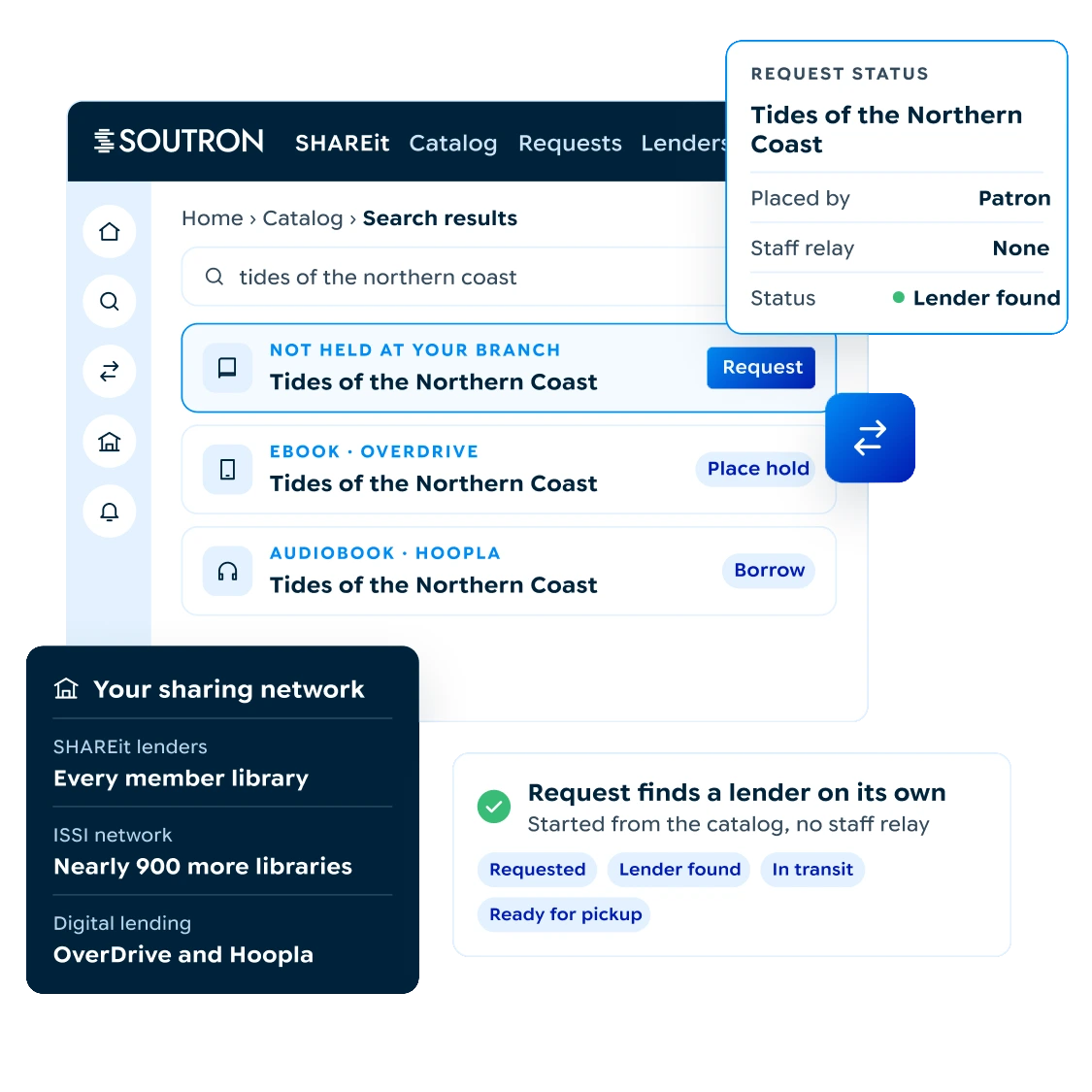
ShareIt works with any ILS, opening your catalog to your sharing network and nearly 1000 more libraries outside of your local network via ISSI.
Patron requests find a lender automatically. Adaptable to your library workflows.
✓ Patrons place the request themselves from the shared catalog. Mediated ILL requests also supported.
✓ A request library in your ShareIt system can’t fill searches a thousand more libraries through ISSI, at no added cost to join.
✓ Ebook and audiobook holds move through the same way a physical loan does.
18 US states and provinces are already running on Shareit
library resources reachable through the ISSI network, at no added cost to join
the year ShareIt started leading online resource sharing
ISO 181626, 10160 and Z39.50 standards supported, so requests move cleanly to any lender’s system
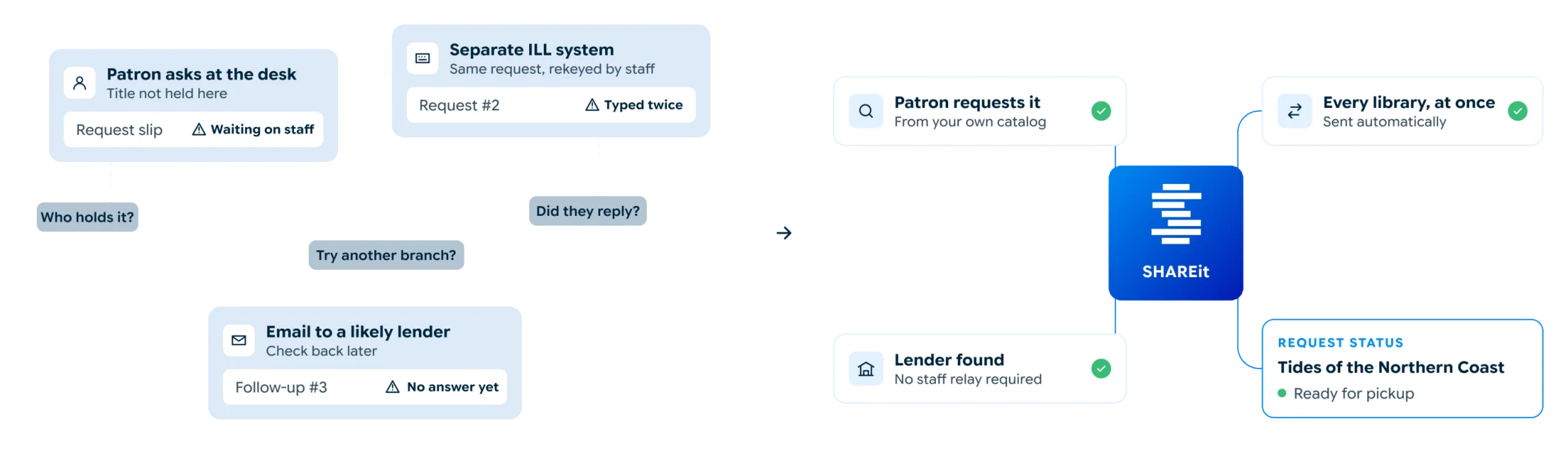
Your branch doesn’t hold everything, and it was never supposed to. But when a patron wants a title you don’t have, someone still has to find out who does. The calls, follow-ups, and emails become endless. Interlibrary loan turns into an inbox your team never signed up to run.
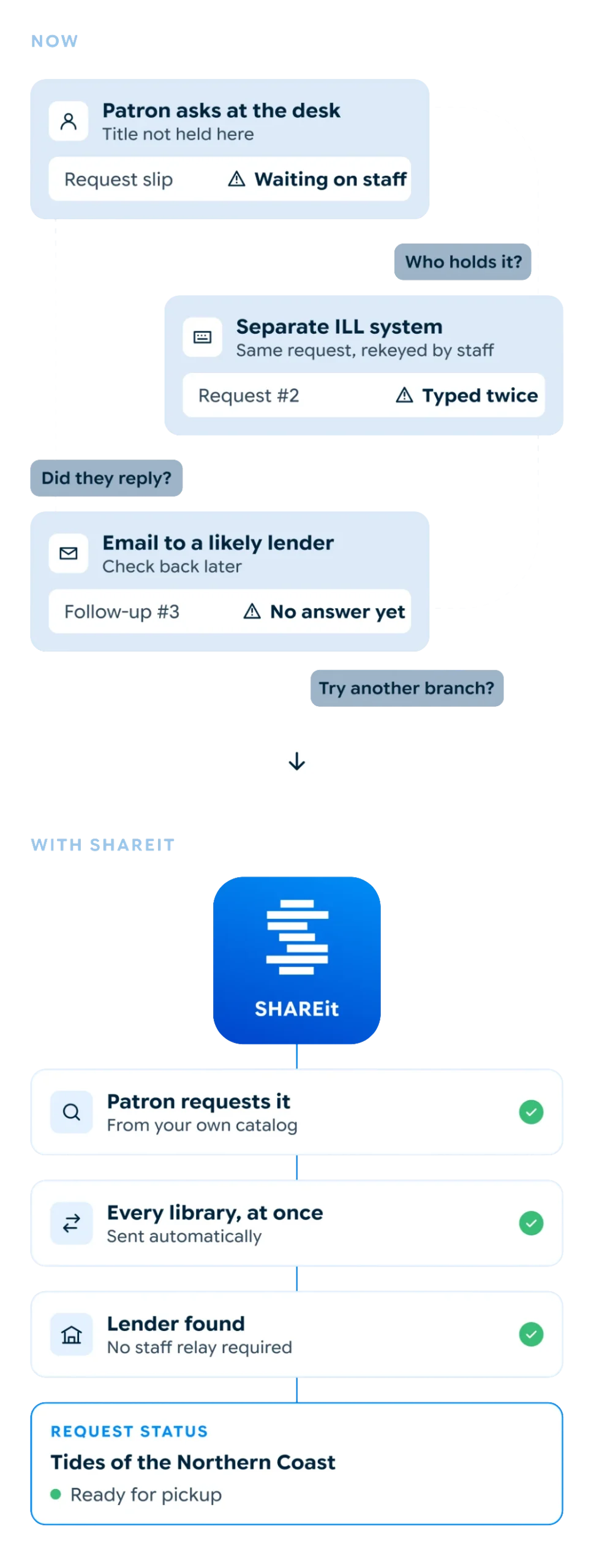
A patron asks for something you don’t hold. Staff rekey the request into a separate system, submit the request, and check back later to see if it ever got answered.
The patron submits the request from your own catalog. The request moves from lender to lender automatically. Calculate staff cost savings using the NCIP staff cost savings calculator.
ShareIt brings every library in your system together in one unified catalog, with patron-initiated or mediated interlibrary loan built in. Patrons use the same login they use for their ILS.
Patrons search every library in your system in one shared ShareIt catalog and place requests themselves. Send them there to look beyond your own collection, or optionally embed ShareIt inside your ILS.
→ ShareIt uses SIP2 or NCIP to authenticate patrons, with NCIP also automating ILL actions in your ILS, so nothing needs rekeying.
→ ShareIt sends each request through as many lenders as it needs, using library-defined lender lists, automatically.
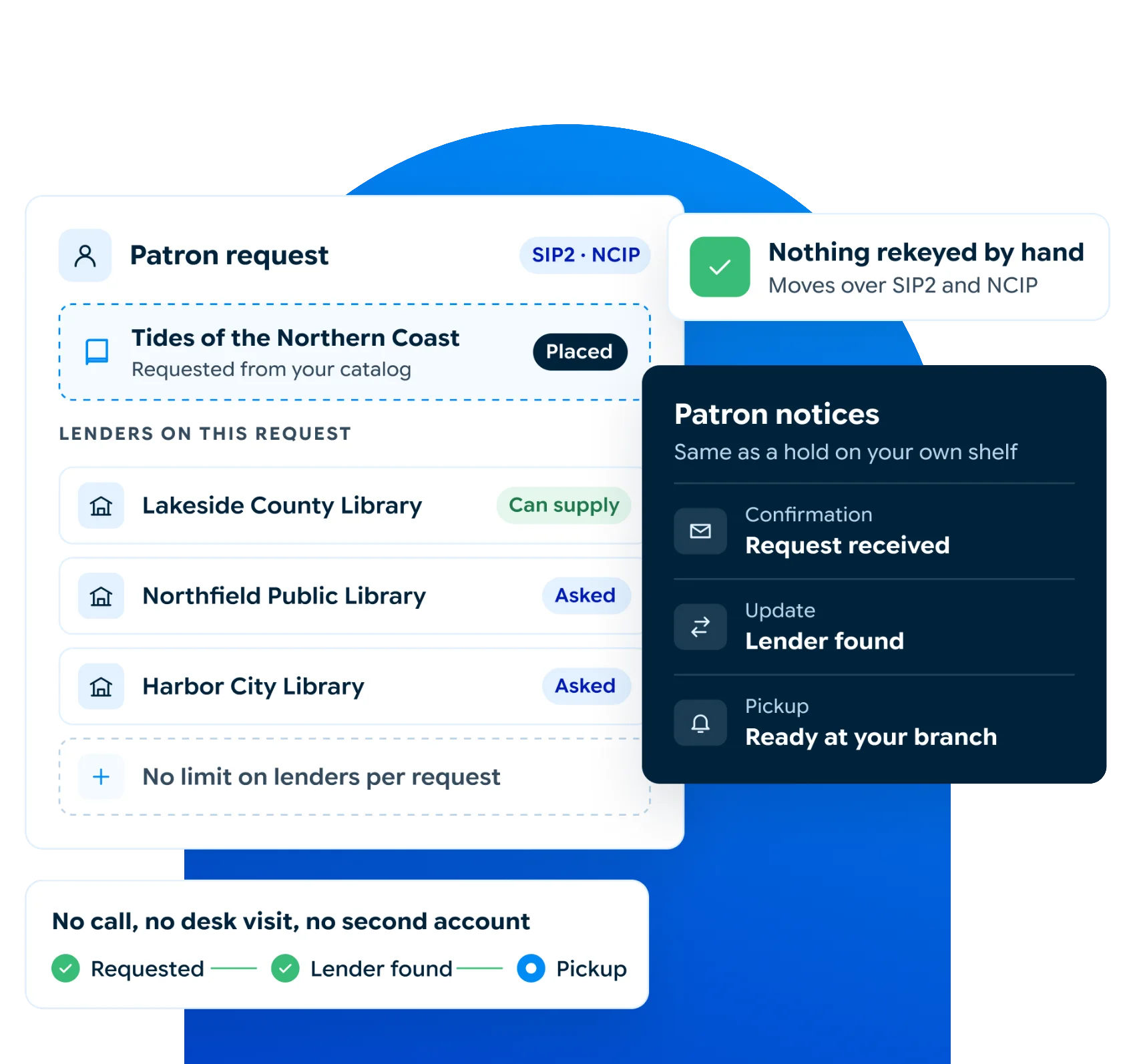
→ Connect ShareIt to your ILS and other systems with Z39.50, ISO 10160/10161, and ISO 18626 to enable patron notifications, the same as they get for a hold on your own shelf.
The Inter-System Sharing Initiative is what happens after a request has already tried every lender in your own ShareIt system and still come up empty.
→ An unfilled request can be offered automatically to the ISSI network.
→ Nearly 900 participating libraries widen what a single branch, or even a single state system, can offer.
→ Joining ISSI carries no added cost.
ShareIt’s ebook and audiobook integration means a digital title doesn’t need its own separate request process to feel just as easy as a physical one.
→ Patrons place digital holds from the same catalog search they’d use for a physical copy.
→ Stay connected behind the scenes, so nobody’s juggling a third login.
→ A collection’s digital reach grows right along with the system, with no separate digital-only budget line to manage.
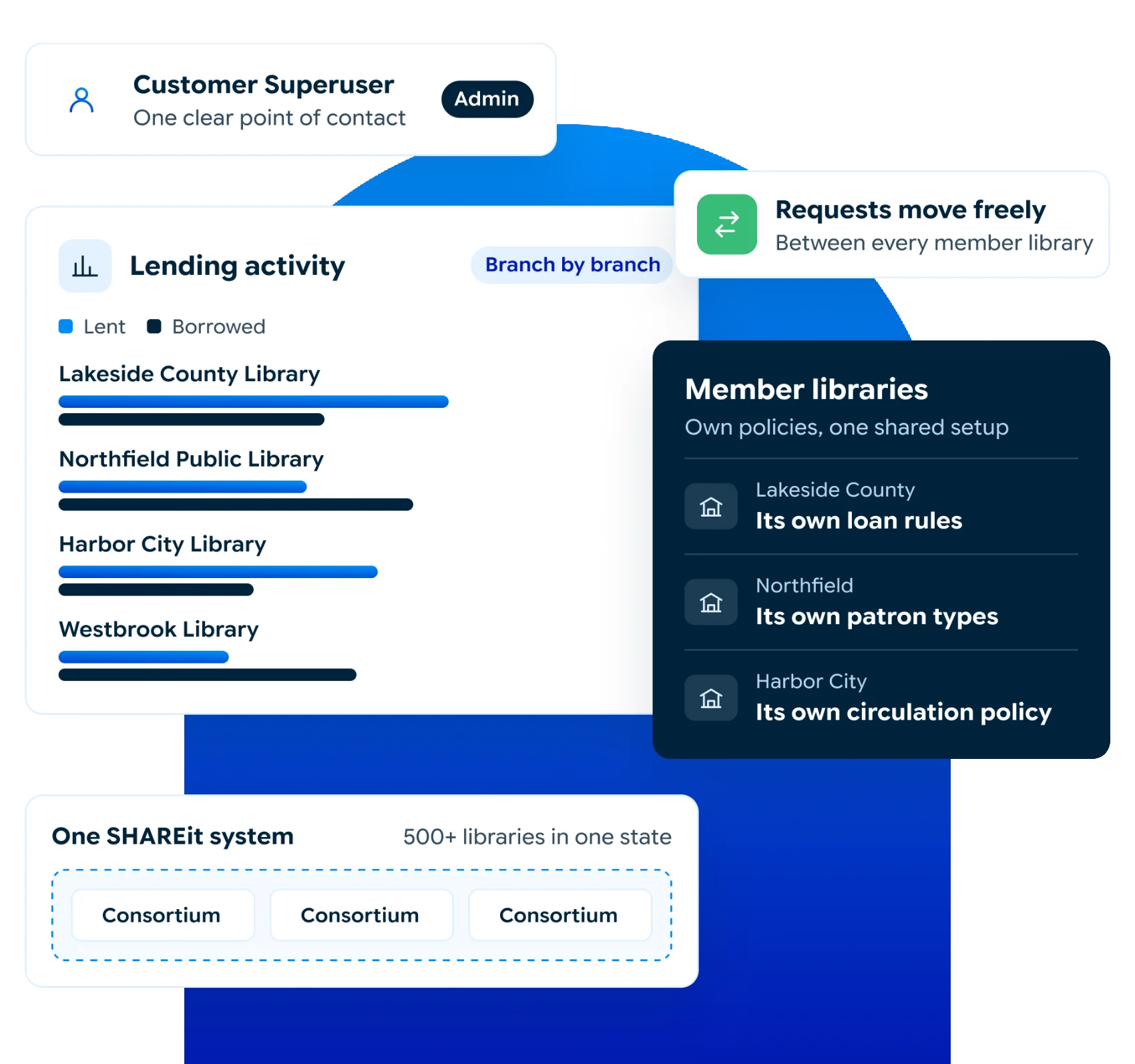
ShareIt serves libraries across a state, a province, or a large region of one. State libraries run most systems, and non-profit groups run others. A single system brings several smaller consortia together. A state the size of Texas or Pennsylvania runs 500 or more public libraries through a single ShareIt system.
→ Each ShareIt system has a Customer Super User who oversees system settings and member participation.
→ Member libraries keep their own circulation policies while requests still move freely between them.
→ Reporting shows what is moving between every member library.
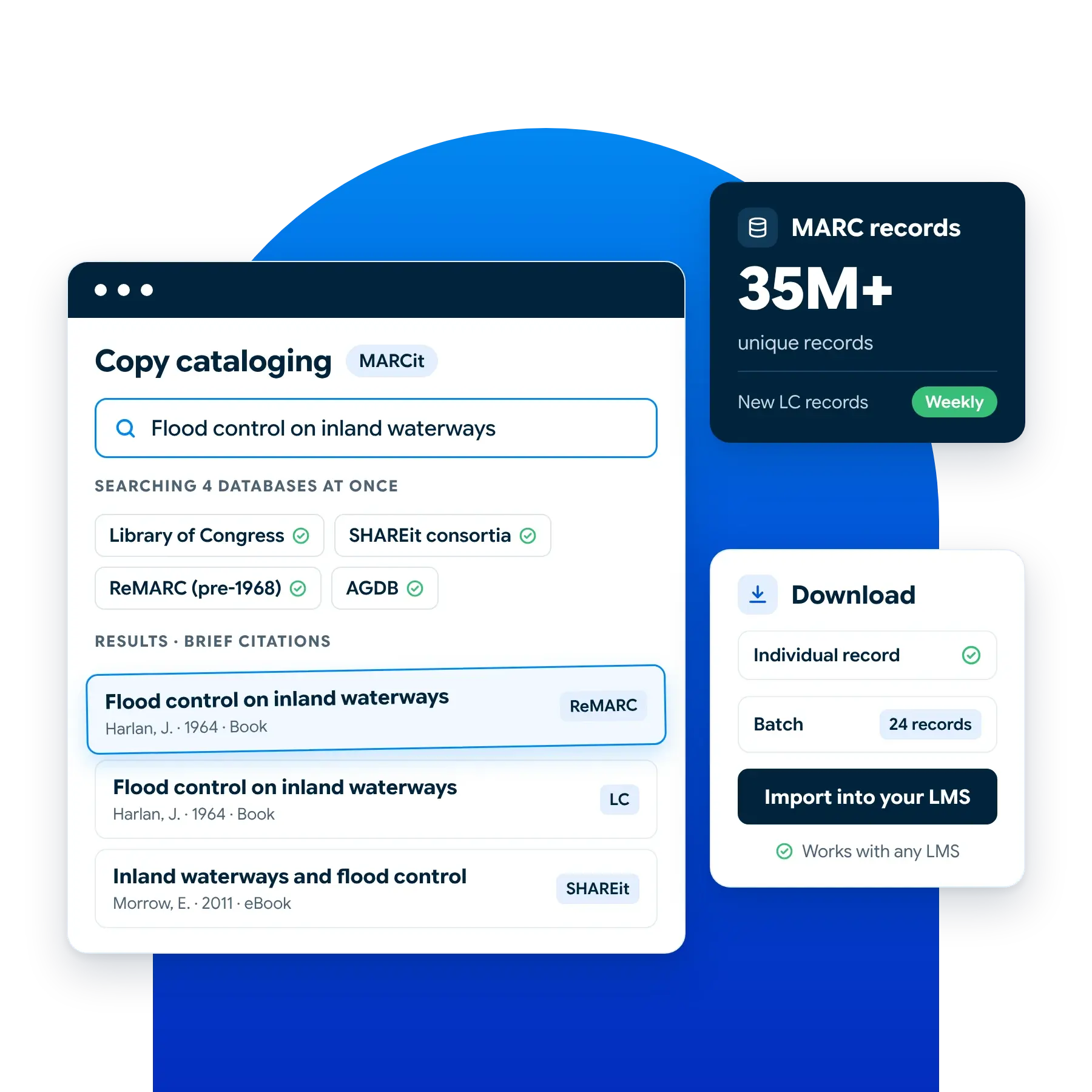
Access over 35 million unique MARC records, updated weekly with new records from the Library of Congress and other verified sources. MarcIt works with any LMS, so you can cut copy cataloging costs, reduce reliance on expensive book vendor records, and free up staff time.
→ Records from LC, ShareIt consortia, ReMARC (pre-1968), and AGDB public library databases.
→ Pull records from an unlimited number of sources into one unified, customizable discovery layer.
→ Export records individually or in batches, ready to import into your LMS, where licensing allows.
Patrons place the request themselves from the shared ShareIt catalog. The request goes to lenders without staff re-entering it. Libraries that want to review requests first can use mediated requests.
A lender who can’t supply a title isn’t a dead end. The request moves to the next one on its own, with nobody rekeying it or starting over.
ShareIt works through every lender on a request automatically, one at a time, with no limit on how many. Your staff only handle it again when the item arrives for your patron.
Nearly 1000 libraries beyond your own system, at no added cost to join. A request your system can’t fill still has somewhere else to go.
Digital lending, built directly into the same catalog and request flow, so a patron never needs a second login just to place a digital hold.
One administrator role per system, so oversight has a clear owner. Settings and member participation don’t fall to whoever happens to notice first.
ShareIt is built for large regional and statewide systems that sit above any ILS and is available for standalone library usage as well. Smaller libraries running Apollo or Artemis often want something lighter. They want to share with a few chosen partners and give up nothing in return. FlexShare does that at no added cost.
Libraries pick their own sharing partners, with no consortium authority above them. Each keeps its own circulation rules, policies, support and billing.
Apollo public libraries and Artemis school libraries share collections. Students borrow from the public library without a separate account, and everyone’s privacy stays protected.
FlexShare lets Apollo public libraries and Artemis school libraries share collections, while each library keeps its own rules, patrons, and data.
Each library keeps its own circulation rules, material types, and patron types, and can set separate lending rules for FlexShare patrons. Join or leave anytime, free, with your data untouched.
Patrons search other libraries’ collections anytime, with any Apollo or Z39.50 library, even without a sharing agreement.
One home library card is all patrons need. Other libraries see personal details only after a loan, and each controls how much.
Patrons borrow from any participating library on one account, and a block at one applies to all. Built on NCIP, FlexShare manages transit and fulfillment.
Get implementation, training, and everyday support with every system, plus a world-class support team ready when you need help.
Get around-the-clock coverage Monday to Friday, with a four-hour response commitment and most tickets answered in 20 to 30 minutes.
Connect with the team and other customers using the same modules. Hear about updates first, share what works, and shape what’s next.
Hand implementation to a delivery team that runs it end to end, from data migration to portal design. We do the heavy lifting so you get up and running quickly.
Train hands-on with every implementation.
Kick-Off
Portal Design
Data Mapping & Migration
Hands-On Training
Hypercare
Ongoing Support
The questions we get the most, answered here first.
Verso and Apollo provide the core library system functions: cataloging, circulation, and the catalog your patrons search. ShareIt offers interlibrary loan across a group of libraries on any ILS. MarcIt speeds up cataloging by searching existing MARC records instead of building new ones from scratch. FlexShare is the optional add-on resource sharing feature set built into Apollo and Artemis, for libraries that want to form their own partnerships. Each is its own product, so you add what you actually need.
ShareIt can be embedded in Verso, so patrons can request interlibrary loans inside the ILS they already use, with no separate login. It adds patron-initiated interlibrary loans: the ability for a patron to request a title held by another library in your system, without a staff member re-entering the request. Mediated loan can be enabled for libraries that want hands-on control.
Not quite, and it’s worth being precise here. A ShareIt system is usually a local or regional group of member libraries sharing one ILL resource sharing network. A single ShareIt system can itself contain several smaller consortia: large states like Texas and Pennsylvania run 500 or more public libraries through one system.
The request deflects automatically to the next available lender, first within your own ShareIt system, and then, if it still isn’t filled, optionally out to the wider ISSI network of nearly 900 libraries. Nobody at your desk has to notice a lender said no and start over.
The ShareIt User group acts as the product’s Advisory Community, where system admins share what works, discuss the challenges of managing a large ILL system with libraries across a state or province, and help shape what’s next.
Each ShareIt system has one designated Customer Super User, a role your team assigns, who oversees settings and member participation for that system. It gives oversight a clear, single owner.
No. Joining ISSI carries no added cost, and it widens your pool of lenders.
ShareIt sits above any ILS and connects large regional and statewide systems. It has one Customer Super User per system and can extend into the ISSI network. FlexShare is built into Apollo and Artemis. Libraries pick their own sharing partners; no central authority runs the process.
It’s FlexShare set up between Apollo public libraries and Artemis school libraries, so public and school libraries can serve a whole community together. Students can use the public library’s collection without a public library account, and personal information stays protected.
Soutron is committed to providing state-of-the-art technology solutions that are accessible for our customers as well as their community of users. We are continually improving the user experience by applying all relevant accessibility standards to our library management and resource sharing software.

Conformance
Soutron strives to embed accessibility throughout our products using WCAG 2.0 guidelines that ensure compliance with Section 508. The WCAG outlines three levels of conformance: level A, level AA, and level AAA. All patron-facing pages are no less than Level AA compliant, with many at Level AAA compliance. A-G’s current conformance to WCAG guidelines is detailed on our VPAT.
Soutron is dedicated to developing our software adhering to the accepted guidelines and standards for accessibility and usability; however, there may be areas within our software and website that aren’t fully compliant. We continue to refine our policies and procedures to ensure compliance with WCAG 2.0 and the revised Section 508.
Measures to support Accessibility Development
The Development team at Soutron incorporates accessibility measures as part of the development process. Working together with Product Managers, we ensure that each feature, function, and enhancement is created to meet, at minimum, the WCAG 2.0 AA standards for 508 Accessibility. The tools utilized for development include:
Google’s Material Design System – Helps teams build high-quality digital experiences for Android, iOS, Flutter, and the web. They define best practices for addressing accessibility. More details can be found here.
Angular Material – Supports building beautiful, usable applications. The components we use already have accessibility built in. More details can be found here.
Testing and Quality Assurance
Our Quality Assurance team utilises third-party tools and assistive technologies when assessing accessibility in our software. The tools utilised are: JAWS screen reader, NVDA screen reader, Dragon Speech Recognition, WAVE (Online Web Accessibility Evaluation) Tool: Evaluates pages and identifies accessibility issues based on Web Content Accessibility Guidelines (WCAG), ANDI (Accessible Name and Description Inspector) Testing Tool: This tool performs testing to detect accessibility issues per page, and the WCAG contrast color-checker tool. The Soutron team evaluates each new feature using NVDA and/or JAWS screen readers and keyboard navigation with every software release. In addition, QA runs a system evaluation at least once a month to confirm accessibility standards are upheld using the tools WAVE and ANDI. The Soutron team is also implementing testing using Dragon Speech Recognition software for the patron interface.
We’re here to help. Reach out to our team, and we’ll get back to you ASAP.
★★★★★
“With the new automated Soutron capabilities, my output has more than doubled.”
★★★★★
“Soutron has been a brilliant massive step forward for us and is now central to everything we do in the library.”
★★★★★
“I find it so much easier to use than any other ILS that I’ve used. It makes sense, it’s more dynamic and its ease of use is great.”
★★★★★
“I like how Soutron listens and services our small special library and archive.”
★★★★★
“Since bringing Soutron onboard, the software has saved our library team huge amounts of time.”